Multimodal Composition of Deltarune
A great example of a multimodal composition, and one I hold dear to my heart, is the independently developed video game Deltarune created and produced by Toby Fox and his team. Every aspect of the game always seems to be changing and playing with the medium it was given. Below, in the order Gagich provided, are the aspects of where Deltarune excells in multimodal composition.
Linguistic
Like many games, dialogue between characters is often the main mode of story telling. Because of the many different kinds of characters introduced, some might have different ways of speaking or quirks to make them stand out.
This is often to tell the player what kind of character they’re meeting. A great example is Roulx Kaard, a character who talks in a Shakespearean dialect to highlight his dramatic, buffoonish behavior. And a subtle example would be Ralsei, a character who speaks in a passive tone, and who acts as a guiding presence for the player. His way of speaking, like Kaard, reflects his behaviors, and adds another layer of character development when he begins to harshen his dialogue with friends.
Catch phrase onomatopoeia are also present in select characters, such as “fahaha” “NGHAA!” and “gya ha ha!” since the game has no voice acting. Certain characters might even have different fonts to make their words match their character. All are creative ways of putting an identifier on a character that matches their motifs, personality, and role in the narrative.
Visual
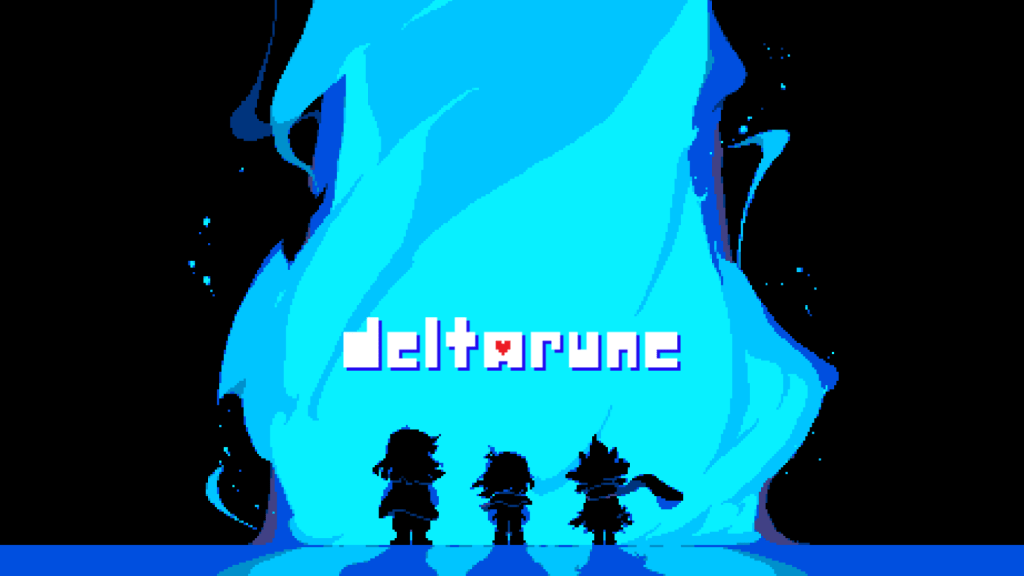
The simplistic pixel art style used in Deltarune creates a nostalgic and charming atmosphere. The game is set in a small, autumn town whose color palette prioritizes high contrast and a brighter scheme. This color choice is then opposed to the Dark Worlds you will enter, which uses black space and saturated UV light colors.
This kind of simple art style also allows for moments like in chapter 4, where an entire animated sequence is implemented at a focal point of the chapter, and creates intensity for the viewer. By using simple graphics, the developers can get creative for intense scenes such as this.
Spatial
Text in the game is put spaced in “text boxes” which only appear when clicking a button. With a button, conversations and actions can be decided and played out.
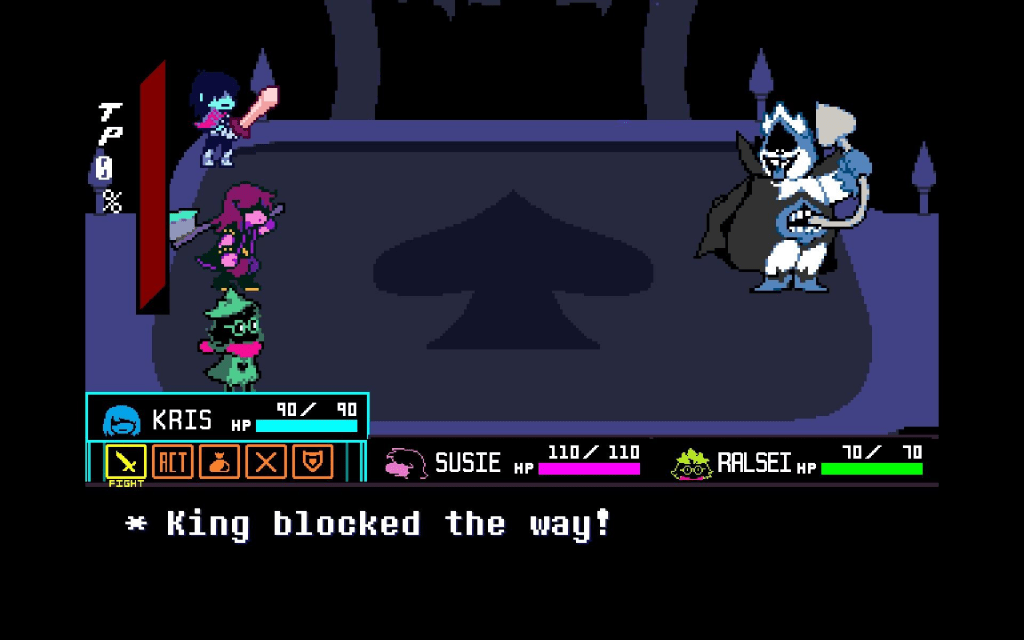
Another great example of how text is spaced out in Deltarune is the fight screen and its various menu options. Every action for the player is divided into sections of the screen and each character has their own unique actions. For example, in the ACT bar on the character Susie, the player can choose the “Rude Buster” act and deal a substantial amount of damage to an enemy. Only she has this action which highlights her aggressive nature.
Gesturial
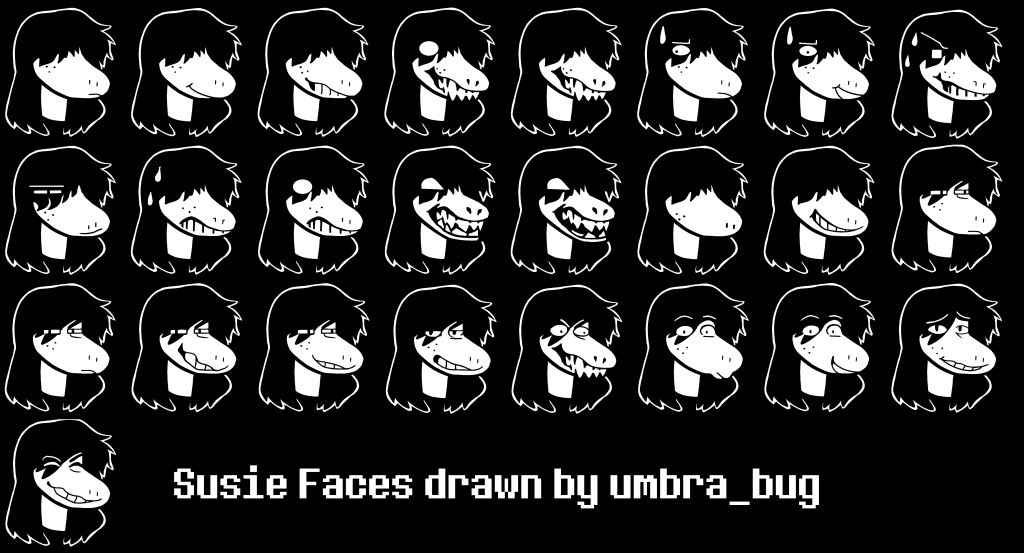
When movement and facial expressions are limited by a simplistic art style, that’s when “character portraits” aid the conversation. Within a text box, a larger scaled image of the character speaking is paired alongside the text. Main characters like Susie have up to 50 different expressions!
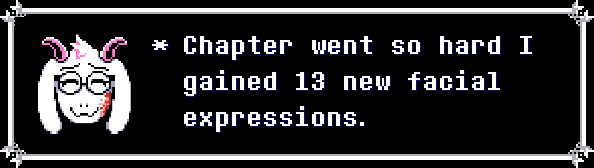
This method allows for intense scenes to play out creatively, too. For example, in a scene of chapter 4, the character Ralsei will not have his portrait showing up until he looks up, and both his sprite and portrait have blood covering one side of his face. The shock of this is enhanced by not showing his face just as much as it was by showing his face.
Aural
There are many funny sound effects used throughout the game, as well as distinct laughs for many certain characters. Each character also has their own text sound effects. Because there is no voice acting in the game, the simplistic vowel sounds that come from characters fills the auditory space, and just like the linguistic marks on character I described before, the text noises serve the purpose of character story telling.
However, what Deltarune is most known for outside of its charming story is its incredible music. Created by the composer Toby Fox, Deltarune and its sister game Undertale are considered to have the best OSTs in indie gaming. There are many fun, light hearted songs and many impressive compositions that create beautiful atmospheres. My personal favorite soundtrack comes from chapter 4, where many of the songs utilize the bells present in the game’s setting to create haunting pieces. “Guardian” “Neverending Night” and “Second Sactuary” are my personal favorites.
Song is also used to portray relationships by using leitmotifs. The characters Tenna and Spamton are most notable for this, and many of spamton’s leitmotifs are used in many of Tenna’s songs. This signals to the player an apparent past between the two characters even before knowing they were once business partners.
The nuance in small details and simplicity are what makes Deltarune so successful. When everything comes together, it all creates an impressive multimodal production that tells a story through puzzle pieces found in each chapter. Repeating phrases, subtle facial expressions, and character references within songs are all parts of a grand whole that makes the game.
One response to “Week 7”
-
Omg, I actually just started playing this game a few weeks ago and it’s like the only thing I can think about. I’m on chapter 2 currently, for reference. I especially liked when you discussed the numerous facial expressions in the game… I had no idea there were that many! This game is peak.
LikeLike


Leave a Reply